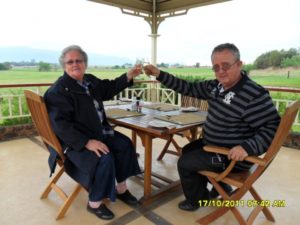
Due to that fact that April is Parkinson’s Awareness Month, as well as to create more awareness regarding this disease, we’ve spoken to Annetjie Peschel about Dries, who is living with Parkinson’s for almost 20 years.
At the end of 1999 the doctors have misdiagnosed Dries with a stroke due to his symptoms and signs – he couldn’t turn over in bed, his right foot started to drag, his right hand gradually tightened and his face turned mask-like. Three and a half years later, in 2003, Dries appeared before a panel of doctors where the professor confirmed that his diagnosis was wrong and that it was Parkinson’s disease. The reason for the misdiagnosis was that Dries never presented with the most common symptom – tremors. For those of you that don’t know this: there are four symptoms of Parkinson’s – tremor, rigidness, Akenisia and posturism (TRAP) and Dries’ main symptom was rigidness.
According to Annetjie they had a tough fight in the beginning, asking questions and trying to make sense of the diagnosis. Acceptance would only come later, but it was something they had to work on constantly. Emotions also played a big role in Dries’ mobility, whether is was joy, sadness, shock, anger, etc. – it would immediately bring about weakening in his body. His decline is worse than other patients where tremor prevails because he goes completely rigid, which then also affects his sight, speech, mobility and ability to chew and swallow. During spasms his head is being pulled down, which in turn affects his eating and swallow abilities. Only the Parkinson’s medication can minimize the spasm and give more mobility.
The medication’s reaction is so unpredictable – one moment it can work for 30 minutes and the next time maybe only for 10 minutes. Protein in his diet also affects the working of the medication in a negative way.
Some Parkinson’s patients have up to 5 pairs of glasses because their sight changes all the time.
Due to Parkinson’s being such an unknown disease Annetjie found it very difficult in the beginning because of her limited knowledge. The adjustment was so great and she had to empower herself with information about a relative unknown disease (at the time of diagnosis) – she had to attend talks, read about the disease and medication and ask medici questions in order to cope.
For Annetjie the biggest demand was to watch Dries deteriorate, get sicker and change (physically and mentally). He changed from a spontaneous person to a more introverted personality because he couldn’t communicate as well as he used to. His big circle of friends shrunk immensely due to people’s ignorance and because they didn’t know how to communicate with him or handle his disease. Annetjie had to learn to control her emotions when she is around him, because any negative reaction from her side, whether it is verbally or body language, is handled very badly by Dries. It takes daily physical, emotional and spiritual adjustments.
Regarding the physical changes, their entire house had to be adjusted: a shower and handles in the bathroom and toilet were required. Their double bed has turned into two single beds, because Annetjie must be able to reach Dries from all sides when she needs to look after him, especially at night.
The spaces have to be big enough to allow a wheelchair and wheelchair ramps had to be placed at the door going in and out. All carpets were removed and replaced with tiles. His cutlery had to be adjusted as well: lighter plates, sippy cups, different cutlery and bibs became the new normal.
Annetjie’s daily chores also changed drastically – she now also had to take over Dries’ male duties, e.g. to have the car serviced when necessary, to drive and the packing and unpacking of the car for travels. She also had to take over his personal grooming: shaving, bathing, getting dressed, eating, drinking, etc. Set times and dates played no role anymore; everything changed.
She is also responsible for his medical care and ensuring that he gets the correct medication at the right times.
The daily planning became her chore, because she knows exactly when to give him his medicine to get him mobile so that they can, for example, go to church, visit friends, go to the doctor, etc.
They also had to make adjustments in their social life because a regular visit with family and friends changed completely. To accommodate a disabled person the host and hostess also had to make adjustments, e.g. wheelchair-friendly houses.
Stimulation and encouragement is very important to combat depression and to counter stagnation seeing as Parkinson’s is a degenerative and socially degrading disease.
It is important to note that support for the carer is just as important as support for the patient.
Annetjie sums it up as follows: “Through it all we had to acknowledge and and recognize our dependence on God. Only He can give wisdom and the power needed every day. You have to ask for patience and tolerance. Without Him nothing will work and you as person need Him for help and assistance. There is so much to be thankful for. We initially blamed the Lord and asked: ‘Why us?’ but the answer to that is: ‘Why NOT us?’”
Dries’ answer to spiritual survival is this: “There is life after a diagnosis” and “Kom dat ons die swaarkry met lekkerkry klaarkry!”